Home / Online Programs / Radiography – Bridge (Non-Entry Level)
Radiography Bridge Associate Degree Program - Online
At a Glance
~20-Month
Program Length
100% Online
Format*
35.5
Transfer Credits Required
95
Program Credits
*Externship required in person
The January 2027 and April 2027 Radiography Bridge cohorts are full, and applications are now closed. The application window for the September 2027 start will be announced at a later date.
Interested in a future Radiography Bridge start? Complete the interest form, and we’ll contact you when application dates become available
If you’re exploring entry into radiography, you can learn more about our Radiography associate degree offered at select campus locations.
About Our Online Radiography - Bridge Associate Degree Program
This associate degree program is designed for limited-scope, military-trained or foreign-educated radiologic professionals who are ready to continue their education and transition into a full-scope radiologic technologist by applying to sit for the American Registry of Radiologic Technologists (ARRT) certification exam. Delivered online with an in-person clinical externship during your final semester, and taught by experienced instructors, course content applies directly to real-world scenarios so you gain the knowledge and training needed to advance your career in radiography. Because you’re already working as a limited-scope radiographer, your existing clinical background and hands-on experience count as real transfer credit toward this degree, so you’re building on what you already know, not starting your education over.
Core Skills You’ll Develop
IMAGING
Advanced radiographic positioning and imaging techniques
PHYSICS
Radiologic physics and principles of exposure
PATIENT CARE
Patient care, safety and radiation protection
PATHOLOGY
Radiographic pathology and image evaluation
Where the Radiography – Bridge Associate Degree Program Can Take You
Qualify to apply to sit for the ARRT certification exam, the step that leads to expanding your scope of practice as a full-scope radiologic technologist.
Build toward post-primary credentials in specialized imaging modalities, such as mammography, CT, MRI, bone densitometry, or vascular/cardiac-interventional radiography.
Eligible credits may transfer toward Pima Medical Institute’s online Bachelor of Science in Radiologic Sciences, helping you build on your education and work toward a bachelor’s degree.
Program Objective
To develop in students the personal and professional skills needed to perform as competent entry-level radiologic technologists. Students will be presented with information in anatomy and physiology, methods of patient care, medical terminology, radiographic techniques, and communications. Graduates of this program receive an Associate of Applied Science Degree and are qualified to apply to take the American Registry of Radiologic Technologists (ARRT) examination for certification.
Program Outline
Semester I
Semester II
Semester III
Semester IV
Semester V
Continue Your Education
Once you’ve earned your ARRT certification, Pima Medical Institute offers additional online programs designed to give registered radiologic technologists the skills needed to move up within their field. The B.S. in Radiologic Sciences builds on your radiography career with a bachelor’s degree completion program, developing leadership, critical thinking and advanced imaging knowledge for career advancement. The Computed Tomography certificate program builds the structured education requirements needed to sit for the CT registry exam.*
*Not available in all US states
Job Outlook
5% Growth — The Bureau of Labor Statistics projects this occupation to grow faster than average over the next 10 years, with a median pay of $81,390 per year.*
*Source: Bureau of Labor Statistics, U.S. Department of Labor, Occupational Outlook Handbook, Radiologic Technologists and Technicians,
at https://www.bls.gov/ooh/healthcare/radiologic-technologists.htm (visited August 18, 2026).
What careers can you pursue with a Radiography - Bridge Associate Degree program?
Graduates of this program who successfully sit for the ARRT Radiography Certification Exam are prepared to apply for positions as a full-scope radiologic technologist, often within hospitals, physicians’ offices, diagnostic imaging centers and outpatient care centers. This credential also opens doors to pursue advanced degrees and specialized imaging modalities down the line.
Student Support
Career Services
When you’re a Pima Medical Institute student, you get access to our Career Services team—here for you when you need extra help with finding the right job opportunities, building a resume, strengthening your interview skills or just looking for general guidance.
Life as an Online Student
When you’re an online student at Pima Medical Institute, you’re part of a supportive learning environment built to help you stay connected and on track. Learn what to expect from online classes, how you’ll engage with instructors and classmates and the resources available throughout your program.
Admissions & Application
Application Process
- Submit the form below
Share a few details so we can prepare for our first conversation.
- Chat with our team
They’ll ask about your background and what you’re looking for in your next step. From there, they’ll help you explore whether the program and online learning experience fit your career goals.
- Attend your virtual tour
Get an overview of the program, curriculum, and what to expect as an online student.
- Complete your application
Our admissions team will walk you through the enrollment process and connect you with financial services.
Radiography - Bridge Associate Degree Program Eligibility Requirements
In addition to Pima Medical’s standard admissions requirements, you’ll need to:
- Document graduation from one of the following: a U.S. military radiography program, an approved or licensed limited-scope radiography program, a JRCERT-accredited radiography program, or a foreign radiography program
- Submit an official transcript documenting a grade of C or better in Medical Terminology
- Document a minimum of 1,599 hours* of recent clinical experience in radiography, gained through education and/or employment (education-based experience is verified through transcript; employment-based experience is verified by an ARRT-registered technologist, supervising physician, or another suitable representative and must include a variety of examinations in your clinical background)

Tuition & financial aid
Federal aid (FAFSA), institutional scholarships, and payment plans are available to help make your education affordable.
Nobody Says It Better Than Our Students
Read our reviews from students and alumni to find out for yourself…
FAQs About Our Radiography - Bridge Associate Degree Program Program
What's the difference between a limited-scope and full-scope radiographer?
A limited-scope radiographer is authorized to perform only certain types of x-ray exams, often on specific body parts, depending on their state and training. A full-scope radiologic technologist, certified through the American Registry of Radiologic Technologists (ARRT), can perform the complete range of radiographic procedures across a hospital or imaging center. This program is designed to help you make that transition.
How do I get certified as a full-scope radiologic technologist?
Completing this program qualifies you to apply to take the American Registry of Radiologic Technologists (ARRT) certification exam, the credential most employers require or prefer for full-scope practice. The program’s final course, Radiography III, is specifically designed to help prepare you for that exam, building on the advanced positioning, physics, patient care, and pathology coursework from earlier in the program along with your in-person clinical externship.
What are the prerequisites for the Radiography - Bridge program?
You’ll need to already be a practicing limited-scope, military-trained, or foreign-educated radiographer with at least 1,599 hours of clinical experience, a transcript showing a grade of C or better in Medical Terminology and passing scores on two entrance assessments. As part of getting to know you, the program also includes a clinical assessment and a conversation with the program team. See the full eligibility requirements above for details.
Am I basically starting my radiography education over?
No. This program is built specifically so you don’t have to start over. You’ll transfer 35.5 credits for your prior radiologic sciences education and clinical experience, and the coursework builds directly on the skills you already have rather than repeating your original training.
Can I keep working while I complete this program?
Yes. Coursework is delivered online and asynchronously, so you can study around your work schedule while still following a steady, predictable schedule of weekly assignments and deadlines. The one exception is your final semester, which includes an in-person clinical externship.
What if I don't pass the ARRT certification exam on my first attempt?
You’re not limited to a single try. ARRT allows candidates three attempts within three years to pass a certification exam, and the first-time pass rate for the Radiography exam was 86% in ARRT’s most recent annual report. If you don’t pass on your first attempt, you can review your score report, focus your study on the sections you missed, and reapply for another attempt.
How do I know if my foreign radiography education qualifies?
Because radiography education varies significantly from country to country, there’s no single, one-size-fits-all answer to this question. Our admissions team reviews foreign credentials individually to determine whether they meet this program’s eligibility requirements. If you completed your radiography education outside the U.S., contact our admissions team to discuss your specific background and how it may apply toward this program.
Can I enroll while still on active military duty?
There’s no inherent barrier to starting the online coursework portion of this program while you’re still on active duty. Many service members take civilian coursework during their service, often using military tuition assistance benefits. Beyond maintaining attendance requirements, the part that typically requires more coordination is the required in-person clinical externship in your final semester, since that depends on being at a fixed location for an extended stretch of time. If you’re currently serving, especially with the possibility of deployment or a change of duty station, talk with your medical career specialist early about timing your enrollment so your externship semester lines up with a stable assignment.
Is financial aid available?
Eligible students may be able to fund their education through federal financial aid programs, including Federal Pell Grants, federal student loans and scholarships. Speak with our financial services team or visit our Financial Aid page to learn more.
What can I do after completing this program?
Completing this program qualifies you to apply to take the ARRT certification exam. Once you pass it and earn your certification, you can practice as a full-scope radiologic technologist. If you want to keep building your career, credits from this program may also transfer toward Pima Medical’s online B.S. in Radiologic Sciences, or, depending on your state of residence, you may be able to pursue additional imaging modalities, such as Pima Medical Institute’s online Computed Tomography certificate.
Are there other modalities I can pursue as a full-scope radiologic technologist?
Yes. Beyond Pima Medical Institute’s own Computed Tomography certificate program, ARRT offers additional post-primary modalities you can pursue independently, including Mammography, Magnetic Resonance Imaging (MRI), Bone Densitometry, Vascular-Interventional Radiography and Cardiac-Interventional Radiography.
Who is the Radiography – Bridge program designed for?
The Radiography Bridge program is built for limited-scope, military-trained or foreign-educated radiographers who are already working in imaging but need the coursework and a clinical externship to become certified as full-scope, licensed radiologic technologists. This is not an entry-level program for someone with no radiography background; it is a bridge program for those looking to expand their current scope of practice and licensure.
Related Resources
Career Advancement led this Graduate to our Online campus
Ronald Davis was looking to advance his career, so he enrolled in Pima Medical’s online advanced placement radiography program (now called RAD Bridge.) He had…
This Online Graduate Continued her Education While Serving Her Country
Yolander Vines is a 2013 graduate of Pima Medical Institute and was able to advance her career with our Radiography bridge program while serving her…
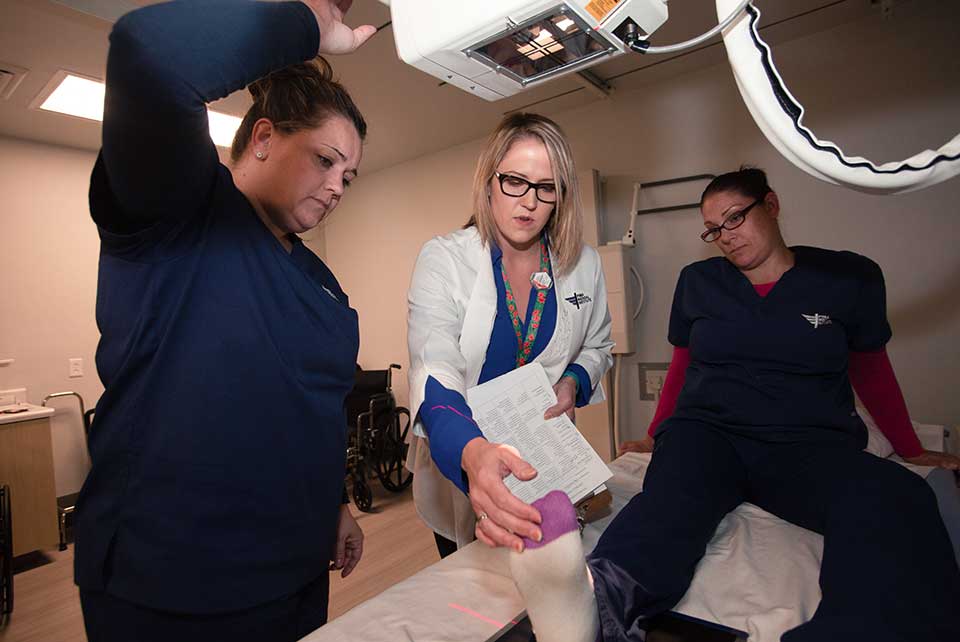
Radiography vs. Radiology: What’s the Difference?
Both radiologists and radiographers play important roles in the healthcare system. And, while each career path deals with issues regarding patient diagnostics and testing, radiologists are generally…
Accreditations and Disclosures
State Licensure Determination Disclosure
The Radiography – Bridge program is offered via online delivery method. Pima Medical Institute is an approved institution through the National Council for State Authorization Reciprocity Agreement (NC SARA) which allows Pima Medical Institute Tucson to offer distance learning programs to residents of states other than Arizona. Participation in NC SARA does not exempt an institution from state professional licensing requirements.
A student’s physical location is determined at the time of enrollment by submission of government-issued identification as well as a student attestation of their physical location in the enrollment agreement. Students agree to update the institution if their physical location changes. Students are able to notify the institution of a change to their physical location in the Pima Medical Institute Student Portal. Prospective students and enrolled students should understand that a change in physical location may adversely impact a student’s ability to complete the program. If a student is planning to relocate he or she is required to discuss this with the Student Services Coordinator and/or Program Director.
In compliance with 34 CFR 668.43 Pima Medical Institute has made a reasonable effort to determine graduate eligibility for licensure in all states for programs designed and advertised as leading to licensure. The document below lists Pima Medical Institute programs and states where the curriculum meets licensure requirements, states where the curriculum does not meet licensure requirements, and states in which Pima Medical Institute has been unable to determine if the curriculum meets state licensure requirements. All consumers should be advised that due to the frequent changes to state statutes, rules, and regulations Pima Medical Institute cannot guarantee licensure based on the lists below.